Cutler Commentary
401(k) Year-End Checklist for Plan Sponsors: 2026 Edition
November 25, 2026
Key Takeaways
-
Most 401(k) plans must adopt SECURE Act, SECURE 2.0, and CARES Act amendments by December 31, 2026.
-
Year-end is a time to confirm notices, contribution deposits, required distributions, and testing.
-
Many missed items can be corrected, but corrections almost always cost more than getting it right the first time.
This checklist is a compilation of compliance, administrative, and fiduciary tasks a plan sponsor should finish before your plan year closes. For 2026, the biggest item is adopting required plan amendments by December 31st. Additionally, you'll want to distribute participant notices, confirm payroll contributions, and review how the plan is actually operating.
At Cutler Investment Group, we work with individuals and families on their wealth management, and with employers on their 401(k) plans. I partner with plan sponsors on the fiduciary and administrative side of their plans, and in the years I have been helping plans, I frequently hear the same issues arise. A lot of competing obligations pop up throughout the year, and the 401(k) items that end up getting missed as a result are rarely the complicated ones. It's the routine ones that slip through the cracks, such as making sure the employer match is being calculated using the correct forms of eligible compensation. I recently helped a plan sponsor get in touch with an ERISA attorney to rectify this very issue, which requires notifying employees and calculating both the missed contributions and the market growth the employees would have earned on that money, too. Between the check they had to write employees and the ERISA attorney's legal fees, this quickly became an expensive error for the business.
As a plan sponsor, you're a fiduciary, and a short, organized review now can keep a small oversight from turning into a costly correction later. Not every item applies to every plan, so confirm details with your recordkeeper, TPA, or ERISA counsel. You can also give me a call and I’ll walk you through this list and how it may apply to you.
What should plan sponsors do before the end of 2026?
Here are the items I see missed most often, along with when each one typically comes due and why it matters.
If this list feels long, don't panic. Start with the amendments and the deposit timing, since those carry the most risk, and work through the rest of the list from there. Each item you check off the list is one less thing to untangle in the new year.
|
Action |
Typical Timing |
Why it matters |
|
Adopt required plan amendments (SECURE Act, SECURE 2.0, CARES Act) |
December 31, 2026, for most plans |
Your governing document potentially won't match up with how the plan now operates, and there's a risk of being non-compliant |
|
Confirm Roth catch-up compliance for higher earners |
Effective January 1, 2026 |
Mishandled catch-ups may need correction |
|
Send Safe Harbor and automatic enrollment notices (if applicable) |
Generally, 30-90 days before the plan year start |
Missed notices can jeopardize Safe Harbor status |
|
Review deposit timing of employee deferrals |
Ongoing |
Late deposits can require corrections and repaying lost earnings |
|
Confirm required minimum distributions (RMDs) are processed |
For most participants the deadline is December 31st, but first RMDs can be delayed to April 1st |
Missed RMDs can trigger excise taxes |
|
Verify eligibility, including long-term part-time employee tracking |
Ongoing |
Excluding eligible employees is a common operational error |
|
Check paper statement delivery |
Plan years beginning after December 31, 2025 |
New annual paper statement requirement |
|
Review testing and data readiness (ADP/ACP, top-heavy) |
Before year-end data is finalized |
Failed tests can mean refunds or extra contributions |
|
Document fiduciary activity |
Before year-end |
Meeting minutes and fee reviews support your prudent process |
|
Prepare for 2027 limits |
Now! |
Payroll and communications should reflect the new limits here |
Not sure what's left on your list? Our advisors can help you with a year-end review. Schedule a complimentary call.
Frequently asked questions about 401(k) year-end compliance
What happens if I miss the plan amendment deadline?
A plan that isn't amended on time can end up with a plan document that doesn't match how it functions, which is a qualification issue. The IRS has correction programs, but they typically involve more cost and effort than adopting on time. If you think you might miss the deadline, talk with your recordkeeper or counsel as soon as possible.
What are the consequences of late employee deferral deposits?
Late deposits are considered a fiduciary breach and a prohibited transaction. Typical remedies include depositing lost earnings and correcting through the DOL or IRS programs. Payroll to deposit timing is one of the most common things reviewers examine, so it's worth checking now.
What if a participant misses a required minimum distribution?
The participant may owe an excise tax on the amount not distributed, though the rate can be reduced if the shortfall is corrected promptly. The plan may also face an operational failure. Make sure you process RMDs before year-end.
What happens if Safe Harbor notices aren’t sent on time?
Late notices can put the plan's Safe Harbor status at risk, which could mean the plan has to run annual nondiscrimination testing for that year. Correction options may exist, so contact your recordkeeper or TPA right away.
What happens if a plan fails ADP/ACP testing?
It generally means refunding contributions to highly compensated employees or making additional employer contributions. Timing matters, because later corrections can bring added costs. Reviewing results early gives you more options.
Who is responsible if our recordkeeper or TPA makes a mistake?
The plan sponsor remains ultimately responsible for oversight, even when tasks are delegated. Keep a calendar of deadlines, request confirmations in writing, and review your service providers periodically.
How do I document that I’ve met my fiduciary duties?
Keep written records of committee meetings, investment and fee reviews, and decisions. A documented, prudent process is often what regulators and courts look at.
Talk with a Cutler Investment Group advisor about your plan
Every plan is different. Fiduciary oversight, plan design, and participant education are our specialty, and our advisors can help you see what's outstanding before year-end. Schedule a complimentary call with our team.
About the author
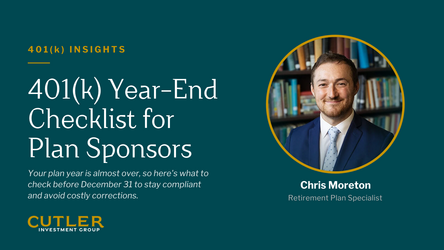
Chris Moreton is a Retirement Specialist at Cutler Investment Group. He partners with business owners and management teams on the fiduciary and administrative side of sponsoring a 401(k) plan. Chris also works one-on-one with plan participants as a financial education and coaching resource.
CATEGORIES

Disclaimer
These blogs are provided for informational purposes only and represent Cutler Investment Group’s (“Cutler”) views as of the date of posting. Such views are subject to change at any point without notice. The information in the blogs should not be considered investment advice or a recommendation to buy or sell any types of securities. Some of the information provided has been obtained from third party sources believed to be reliable but such information is not guaranteed. Cutler has not taken into account the investment objectives, financial situation or particular needs of any individual investor. There is a risk of loss from an investment in securities, including the risk of loss of principal. Different types of investments involve varying degrees of risk, and there can be no assurance that any specific investment will be profitable or suitable for a particular investor's financial situation or risk tolerance. Any forward looking statements or forecasts are based on assumptions and actual results are expected to vary. No reliance should be placed on, and no guarantee should be assumed from, any such statements or forecasts when making any investment decision.